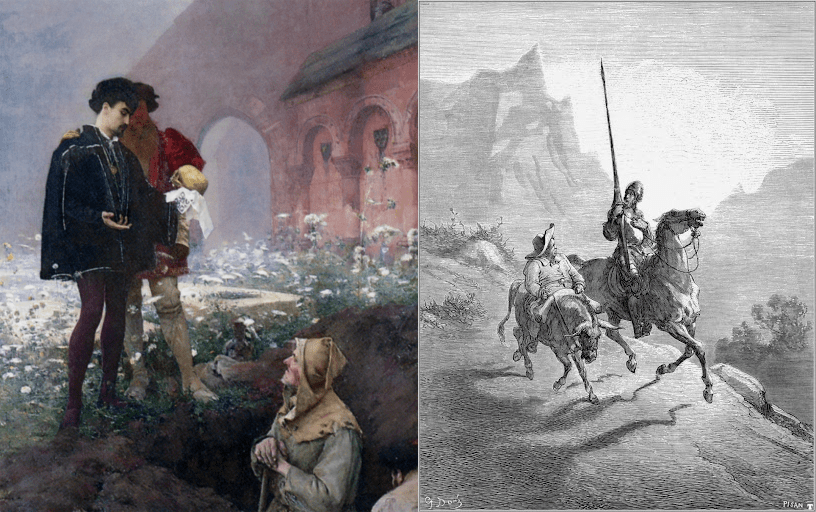
In William Shakespeare’s Hamlet (1623) and Miguel de Cervantes’ Don Quixote (1605), the respective protagonists are existentially bound to the continuity of performance. In this vein performance becomes a vital element of the respective characters ontologies: in Hamlet, the Kingdom of Denmark is filled with characters who conceal their true selves beneath performative roles, while in Don Quixote, the knight errant’s delusion of grandeur reconfigures reality itself, transforming the ordinary into the extraordinary. Both authors explore this theme to the extent that each character’s demise becomes intimately connected to the dissolution of their own theatrics. It seems, in both texts, that once the veil of performance is lifted and truth is revealed, there are apocalyptic repercussions for both the diegetic reality within the texts. By examining the role of performance and delusion in either texts, Shakespeare and Cervantes appear to exhort that fiction is essential to the preservation of reality—as the grammar that is necessary to interpret reality and give it material form. This essay will argue that the revelation of truth in the performative world of Hamlet and Don Quixote, results in the coinciding annihilation of the characters’ diegetic realities, respectively.
In the world of Hamlet, the quintessential nature of theatrics and illusion is established in the opening lines of the play, when Barnardo asks: “Who’s there?”, to which Francisco replies: “Nay, answer me […] Stand and unfold yourself,” Shakespeare unveils to the audience that actuality in the world of the play is to a certain extent fettered, and can thus be “unfold[ed]” (Hamlet 1.1.1-2). The veil of illusion that hangs over the world in the play is further explicated in the tactically deceptive roles which certain characters deploy in an effort to mask their true identity. In a scene that all too closely mirrors the staging of a play, Polonius and Claudius orchestrate a plot to survey the root of Hamlet’s “antic disposition” (1.5.179). Claudius lays out the plan: “as ‘twere by accident, [Hamlet] may here / Affront Ophelia / […] Her father and myself, lawful espials, / Will so bestow ourselves that, seeing unseen, / We may of their encounter frankly judge” (3.1.31-5). In this scene, Hamlet is being behaviourally “judge[d]” in respect to the nature of his disposition—his emotions, reactions, and language—all of which are used by Claudius and Polonius as evidence for his supposed madness. Yet, in an earlier scene that seems to prototypically respond to Claudius and Polonius’ empirical method of observation, Hamlet suggests that what is external “can[not] denote […] [him] truly” (1.2.86). In this vein, Hamlet seems to imply that his embodied existence in the play is inextricably performative. Because his internal being can only self-consciously be recognized, Hamlet’s observable self is reliant on the external facade of his role.
The simulacra of performance mounts atop the play as Polonius becomes stage director: “Ophelia, walk you here […] Read on this book, / That show of such an exercise may color / Your loneliness” (3.1.44-7). Ophelia is granted the role of a pious woman in solitude, strategically being placed by Polonius to act as bait for Hamlet, who—in reaction to the performative role of Opheila—is expected to follow the script as a madman. This scene establishes that the Kingdom of Denmark operates on the constructed theatrics of the performing roles in it. In essence, the diegetic reality of Hamlet is formed through the interplay between character’s constructed fictions—the “actions that a man might play” (1.2.84).
Just as performance and fiction are existentially tethered to the character in Hamlet, the knight-errant in Cervante’s Don Quixote is likewise sustained by performance. In Don Quixote, fiction entirely overcomes the reality of Alonso Quixano, transforming him into the chivalric knight-errant. In this respect, Cervantes portrays a delusional man whose “mind was completely gone” (Don Quixote 21) as he forgoes reality to immerse himself in his knightly fantasy. Moreover, Quixote must maintain his delusion of grandeur to sustain his very identity, relying on his imagination to reshape reality into his fabricated realm of existence—a realm of “combats, battles, challenges, wounds, courtings, loves, torments, and other impossible foolishness” (21). Any incursion of actuality into this fantasy amounts to an existential attack on his very being. In response to his neighbour’s claim that he is Señor Quijana—thus unintentionally challenging his self-fashioned identity as a knight-errant—Quixote replies: “I know who I am, […] and I know I can be not only those who I have mentioned but the Twelve Peers of France as well, and even all the nine paragons of Fame.” (43) This exchange reveals that his identity is maintained not by any tangible sense of reality but solely through the chivalric figures of his cherished novels.
Furthermore, Quixote—in a desperate bid to resolutely maintain his fabricated reality as a fictitious knights-errant—posits: “I think, and therefore it is true, that the same Frestón the Wise who stole my room and books has turned these giants into windmills in order to deprive me of my glory[,] […] his evil arts will not prevail against […] my virtuous sword” (59). The notion that Quixote “think[s], and therefore it is true” (59), suggests that the knight-errant’s reality is not empirically evident and is instead a subliminal fixture of his imagination. Quixote must remain steadfast in his delusion as it hinders on his being as knight-errant—if the fiction as a knight-errant ceases, the infamous Don Quixote of La Mancha is reduced to nothing. When the “evil arts” (59), or the imposition of actuality, threaten to dismantle his chivalric delusion, Quixote reconfigures his reality around him—insisting that an evil sorcerer turned the giants into windmills to thwart his “virtuous sword” (59), or his fantastical fiction.
Once the meticulous veil of performance and fiction is lifted in Don Quixote and Hamlet, apocalyptic repercussions ensue. In Hamlet, this takes form at the end of the play when—rather than a catharsis or moral clarity—the revelation of the truth instead delivers the kingdom of Denmark to near annihilation. In an earlier scene when Hamlet is in conversation with Rosencrantz and Guildenstern, Rosencrantz ironically says to Hamlet: “the world’s grown honest,” to which Hamlet immediately calls out as “not true” (2.2.234-5). Hamlet even suggests that if “the world’s grown honest” (2.2.234), then “doomsday [is] near,” implying that fiction is the sole mode of a stable reality. Quite literally, Shakespeare is implying that the end of the world—or the play on the Globe Theatre stage, in a metatheatrical sense—would be irrevocably destroyed if the actors on stage performing Hamlet were their honest selves, and if the characters in Hamlet were their honest selves as well.
This is put to the test in the “Murder of Gonzago” play that Hamlet puts on, wherein the play—once it reflects actuality too closely—is shut down. Hamlet says to one of the players: “Speak the speech, I pray you, as I pronounced it to you, […] you must acquire and beget a temperance that may give it smoothness” (3.2.1-7), suggesting that the speech must be portrayed in a realistic rather than dramatic manner—a manner that does not “o’erstep the modesty of nature (3.2.16-7). Through this, Hamlet seeks to confirm Claudius’ guilty conscience by holding a “mirror to nature” (3.2.19)—“A play […] before the King” that mirrors “the circumstance / of […] [Hamlet’s] father’s death” (3.2.67-9). As a result of the play verging on truth—the murder of Hamlet’s father—the play is shut down and the fictitious characters involved cease to exist. This suggests truth must be revealed in tandem with a manner of annihilation.
Similar to the disillusionment of the characters in the “Murder of Gonzago” play, by the end of Hamlet, the characters are unwilling to disentangle their performative roles from their true selves. The final fight between Laertes and Hamlet is a staged production—directed by Claudius—that falls apart, wherein Gertrude drinks from the poisoned cup meant for Hamlet, Laertes reveals “the King’s / to blame” (5.2.306), and Hamlet kills both Laertes and Claudius. Hamlet, before succumbing to the poison tipped sword, suggests that a mute “audience […] / [watches] this act” (5.2.320), and even references his life as a “story” to be told (Hamlet). Once the theatrical roles of the characters are annihilated, the lives of the characters conclude with the revelation of truth. Hamlet, once left without the role’s he’s taken on—his “antic disposition” or his role as vengeful son—is left without form: “The rest is silence” (5.2.343) he says.In Don Quixote, the prudence of succumbing to reality—a revelation that is bestowed upon the novel’s protagonist by God, results in the knight-errant foregoing his chivalric quest, and regaining an awareness of who he truly is, Alonso Quixano the Good. Quixote details his reimmersion into the material world: “judgement is restored, free and clear of the dark shadow of ignorance imposed on it by […] [the] reading of […] books of chivalry” (Don Quixote 935), and in doing so exhorts to the reader that the “shadow of ignorance” (935), or the chivalric delusion, has effectively been dislodged, allowing the truth to finally prevail for Quixano the Good. However, as has been meticulously detailed by the protagonist’s reliance on delusions to maintain his sense of reality, Quixano’s existence appears to be inextricably bound to the fictitious realm of the knight-errant Don Quixote. In this vein, the final renunciation of his fictitious identity rescinds the only means by which Cervantes’ bibliophile protagonist can sustain himself within reality. This morbid consequence—where truth proves incompatible with existence—is recounted by Cervantes amidst Quixano’s dying words: “Those [tales] that until now […] have been real […] will […] be turned to my benefit by my death” (936) which, in deference to his lifelong escapism through fiction, affirms that the end of his fictitious pursuits has the power to draw him from existence altogether, and transport him to the afterlife.
 phoenixswriting